

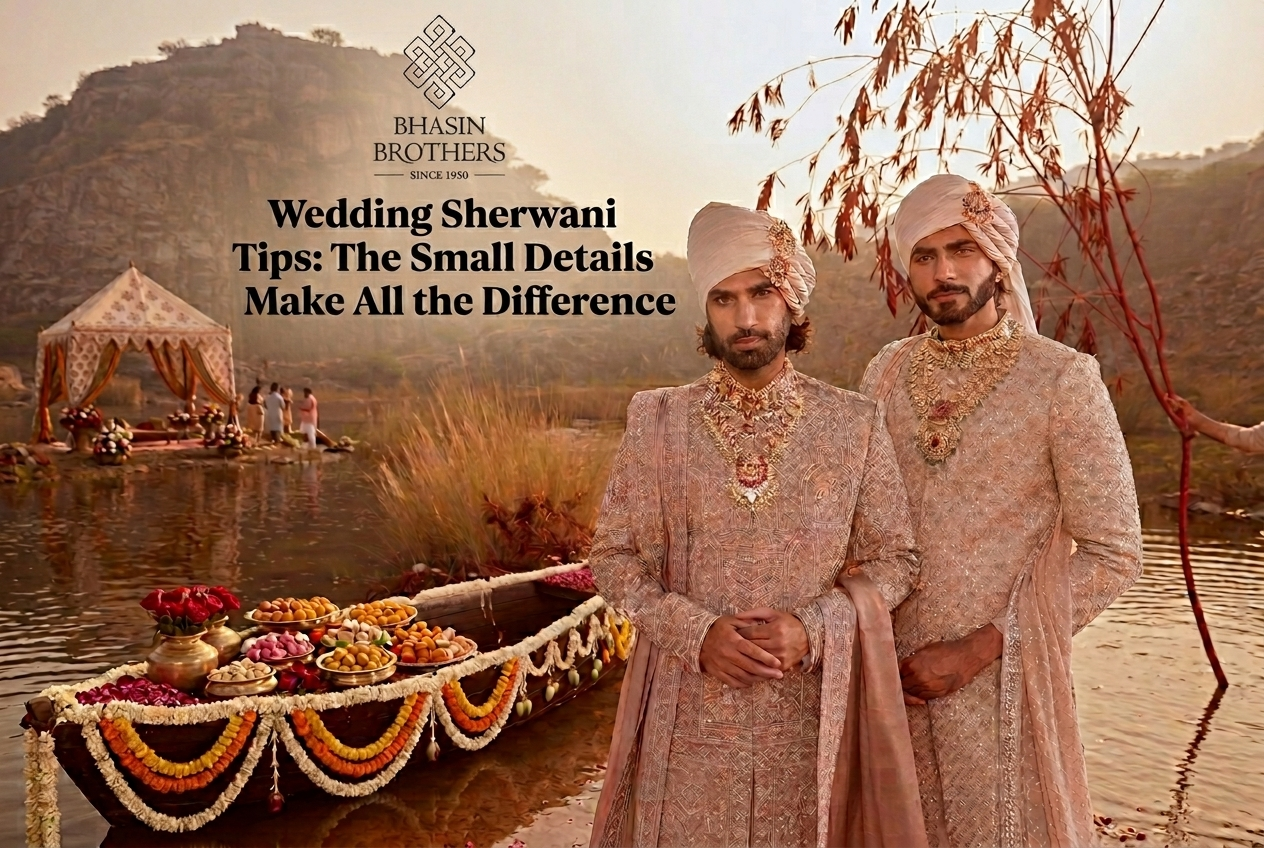
Wedding Sherwani Tips: The Small Details That Make All the Difference
A groom in a beautifully crafted sherwani — standing tall, silk gleaming under the mandap lights — is a vision that stays with guests long after the wedding is over. At Bhasin Brothers, with over 75 years of heritage in Indian ethnic wear, we know that the sherwani you choose for your wedding is not merely a garment. It is a statement, a memory, a heirloom in the making.
But choosing a stunning piece is only the beginning. It is the finer details — fit, fabric, accessories, coordination — that truly separate the unforgettable groom from the forgettable one. This guide walks you through every detail that matters.
Is Your Wedding Sherwani Missing the Perfect Fit?

You could own the most exquisitely embroidered sherwani in all of Lucknow — but if it does not fit you perfectly, none of that craftsmanship will translate on your wedding day. Fit is the single most important variable in how a sherwani looks and feels, and it is the detail most grooms tend to overlook when dazzled by colour and embroidery.
A well-tailored sherwani must sit precisely at the shoulders — no bunching, no pulling. The sleeve length should fall at the wrist bone. The chest should have just enough room to breathe without drag. The length should ideally reach the knees or just below, depending on your height and the style.
|
BB Expert Tip: Custom Over Ready-to-Wear |
|
At Bhasin Brothers, we offer a Made-to-Measure service that allows you to customise your sherwani down to every measurement. For a once-in-a-lifetime occasion, a custom fit is always worth it — the difference between looking good and looking extraordinary. |
The Perfect Fit Checklist

- Shoulders: The seam should sit exactly at the edge of your shoulder — not over it, not inside it.
- Chest: A flat palm should slide in comfortably — snug but never tight.
- Sleeves: Cuffs must fall exactly at the wrist bone, revealing just a hint of inner kurta cuff.
- Length: Classic sherwanis sit at or just below the knee. Shorter lengths suit modern Indo-western cuts only.
- Churidar: Should gather in neat folds at the ankle — never drag on the ground.
Choosing the Right Fabric for Your Wedding Sherwani

The fabric of your sherwani determines not just its visual richness, but also how comfortable you will be through your long wedding day. A groom who is overheating at a summer outdoor ceremony is not going to look his best — no matter how beautiful the embroidery on his sherwani is.
Rich fabrics like pure silk, Banarasi brocade, and velvet are ideal for winter weddings, evening ceremonies, and grand indoor venues. For summer weddings or destination ceremonies, opt for cotton-silk blends, tissue silk, or linen blends — lightweight fabrics that keep you cool while still looking regal.
Fabric Guide by Season and Venue

- Pure Silk: The gold standard for wedding sherwanis. Lustrous, breathable, and embroidery-friendly.
- Banarasi Brocade: Intricately woven with zari work. Luxurious and heavy — best for winter or indoor weddings.
- Velvet: Deep, opulent texture. Reserve for winter evenings and royal-themed weddings.
- Tissue Silk: Semi-sheer with a natural shimmer. Elegant for summer weddings and receptions.
- Cotton-Silk Blend: The pragmatic choice for warm-weather outdoor ceremonies.
- Georgette: Lightweight and fluid — popular for mehendi and haldi functions.
Sherwani Styling Mistakes Every Groom Must Avoid

Even grooms with great taste can stumble into common styling traps that undercut an otherwise stunning sherwani. Knowing what not to do is as important as knowing what to choose.
- Ignoring the bride's outfit: Your sherwani and your bride's lehenga will be photographed together for a lifetime. Coordinate colours, embroidery style, and aesthetic to create a harmonious couple look.
- Over-matching: Wearing an identical shade to your bride can look costume-like. Coordinate, don't twin — choose complementary, not identical tones.
- Wrong embroidery for the venue: Heavy zardozi and stonework read magnificently in a ballroom; they can look out of place at a daytime garden wedding.
- Skipping the trial run: Always do a full dry run in your sherwani — including the churidar, footwear, and turban — at least a week before the wedding.
- Over-accessorising: A sherwani is already a statement. Layering too many necklaces, rings, and brooches creates visual noise. Choose two or three key accessories.
- Wrong footwear: Sneakers or ill-fitted mojaris can ruin even the most magnificent sherwani. Invest in a well-crafted pair of embroidered juttis.
Styling a Designer Sherwani with the Right Accessories

Accessories are where a great sherwani becomes an unforgettable look. They are the punctuation marks of your bridal ensemble — chosen well, they amplify, chosen poorly, they distract. The key principle is harmony without competition accessories should elevate the sherwani, not compete with it.
|
The Groom's Accessory Checklist |
|
Turban (safa) | Brooch | Stole or dupatta | Kamarband | Mojari/jutti footwear | Minimal jewellery (one ring, optional pearl necklace) | Pocket square | Optional: sehra for baraat |
Your turban is your crown. Choose a shade that either matches your sherwani exactly for a regal monochromatic look, or pick a contrasting colour that coordinates with a detail in the embroidery — a burgundy brooch against an ivory turban can be a magnificent touch.
A kamarband (waistband) is making a strong comeback and is particularly effective on sherwanis with minimal waist embroidery — it adds definition and structure. A stole or dupatta draped across the shoulder adds dimension and a touch of classical grace.
For jewellery, restraint is sophistication. A single ring in gold or kundan, a subtle pearl necklace, or a wrist bracelet is all that a sherwani typically needs. Leave the statement jewellery to the bride.
How to Choose the Right Colour for Your Wedding Sherwani

Colour is the first thing people notice and the last thing they forget. Your sherwani colour communicates your personality before you have said a word, and it creates the visual anchor of your entire wedding aesthetic.
- Ivory and Cream: The perennial groom classic. Timeless, elegant, and a perfect canvas for intricate embroidery. Pairs magnificently with rich reds and pinks.
- Gold and Beige: Rich and warm — ideal for formal, traditional ceremonies. Gold sherwanis with zardozi work are particularly popular in North Indian weddings.
- Peach and Rose Gold: Romantic and contemporary, these pastels are trending strongly in 2026 and coordinate beautifully with blush or champagne bridal outfits.
- Navy and Royal Blue: The power choice for grooms who want to stand confidently apart. Blue sherwanis photograph dramatically.
- Maroon and Burgundy: Deeply traditional and festive — perfect for winter weddings with a classic, grand feel.
- Mauve and Lilac: The 2026 standout choice for fashion-forward grooms. Pairs strikingly with lavender, silver, or deep plum bridal wear.
The Right Sherwani for Every Wedding Function

A modern Indian wedding is a multi-day celebration, and each function calls for a different energy — and therefore a different look. At Bhasin Brothers, we curate our collection around every moment of your wedding journey.
- Haldi Ceremony: Keep it light and vibrant. Yellow, saffron, or turmeric-toned kurta sets in cotton or linen work beautifully here.
- Mehendi and Sangeet: Embrace colour and celebration. A pastel Indo-western sherwani or embroidered kurta jacket in mint, peach, or powder blue is ideal.
- Baraat and Main Wedding Ceremony: This is the moment for your statement sherwani. Go all out — silk or brocade with hand embroidery, your finest turban, and all your accessories.
- Reception: Many grooms opt for a sharp bandhgala suit, a tuxedo with Indian accents, or a sleek contemporary sherwani in a deep jewel tone.
- Engagement: A mid-weight sherwani or tailored bandhgala in a smart navy or charcoal with subtle embroidery strikes the perfect note.
Frequently Asked Questions :
Q: What accessories should I wear with a wedding sherwani?
A: Pair your sherwani with a coordinating turban (safa), a decorative brooch, a stole or dupatta, and embroidered mojari footwear. For jewellery, keep it minimal: a single ring in gold or kundan, and an optional pearl necklace. A kamarband adds elegance and structure. A pocket square is a small but memorable finishing touch.
Q: What is the best fabric for a wedding sherwani?
A: For winter or indoor weddings, pure silk, Banarasi brocade, and velvet are the finest choices. For summer weddings and outdoor or destination ceremonies, opt for tissue silk, cotton-silk blends, or linen blends that keep you comfortable without sacrificing elegance.
Q: How do I choose the right colour for my wedding sherwani?
A: Start by coordinating with your bride's lehenga — the palette should feel harmonious in photographs. For winter and evening weddings, richer shades like ivory, gold, navy, and maroon are ideal. For summer or daytime weddings, pastels like peach, cream, and mauve look fresh and elegant.
Q: Classic sherwani vs. modern Indo-western — which should I choose?
A: A classic sherwani with traditional embroidery and a churidar is timeless and universally appropriate for formal wedding ceremonies. A modern or Indo-western sherwani with contemporary cuts and layered silhouettes is a great choice for fashion-forward grooms or for functions like mehendi, sangeet, or reception.
Q: How early should I order a custom wedding sherwani from Bhasin Brothers?
A: We recommend placing your order at least 8 to 12 weeks before your wedding date. Custom sherwanis require multiple measurements, skilled hand-embroidery, and fitting sessions. For peak wedding seasons (November to February and April to June), booking even earlier is advisable.

Written by Bhasin Brothers